
If you are starting a new job and your manager asks you to complete an online module at home without pay, you are probably wondering: is unpaid training legal? For millions of hourly American workers, the boundary between legitimate onboarding and illegal corporate wage theft is deliberately blurred by employers trying to save a buck.
Let’s be absolutely clear. You do not work for free. Your time is your most valuable asset, and federal law fiercely protects it. Modern HR departments often use manipulative jargon like “skills assessment” or “highly recommended viewing” to trick you into off-the-clock work. Knowing exactly when you are legally required to be paid is your best defense against losing the money you rightfully earned. Let’s break down your federal rights.
Is unpaid training legal under federal labor laws?
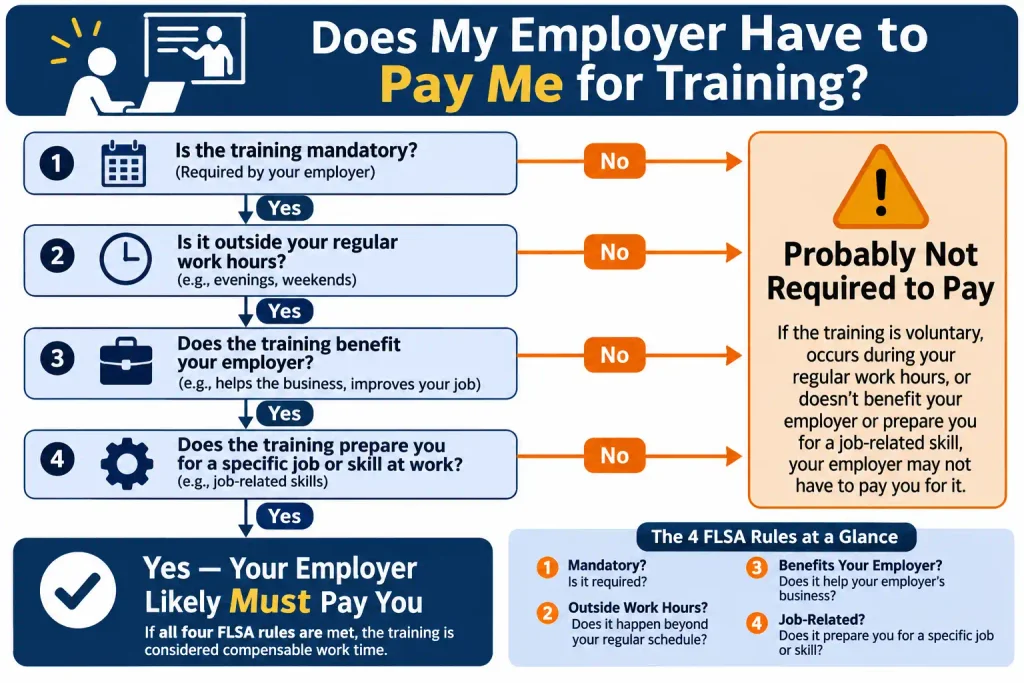
Generally, no. Under the FLSA, unpaid training is only legal if it meets four strict conditions: it is outside normal hours, completely voluntary, unrelated to your current job, and involves no productive work. If any condition fails, it is Compensable Time that must be paid.
Understanding the FLSA 4-Part Test for compensable time
The Fair Labor Standards Act (FLSA) is the foundational federal law protecting your paycheck. Under the Code of Federal Regulations (29 CFR § 785.27), the U.S. Department of Labor (USDOL) established The FLSA 4-Part Test.
For a training session to be legally unpaid, an employer must prove that all four of these conditions are true at the exact same time:
- It is outside your regular working hours.
- Attendance is truly voluntary.
- The course is not directly related to your current job.
- You perform no productive work during the training.
If even one single condition fails, the session instantly becomes Compensable Time. You must be paid for it.
Why mandatory attendance and new-hire orientation always trigger minimum wage
The difference between Mandatory vs. Voluntary Attendance is the most common place employers break the law.
New-hire orientation, safety videos, and policy reviews are never truly voluntary. Because they are required for you to keep your job, they fail the FLSA 4-Part Test immediately. Therefore, any mandatory onboarding must be paid at your standard Minimum Wage and Overtime rate. You cannot be forced to sit in a back office watching food safety videos for zero dollars an hour.
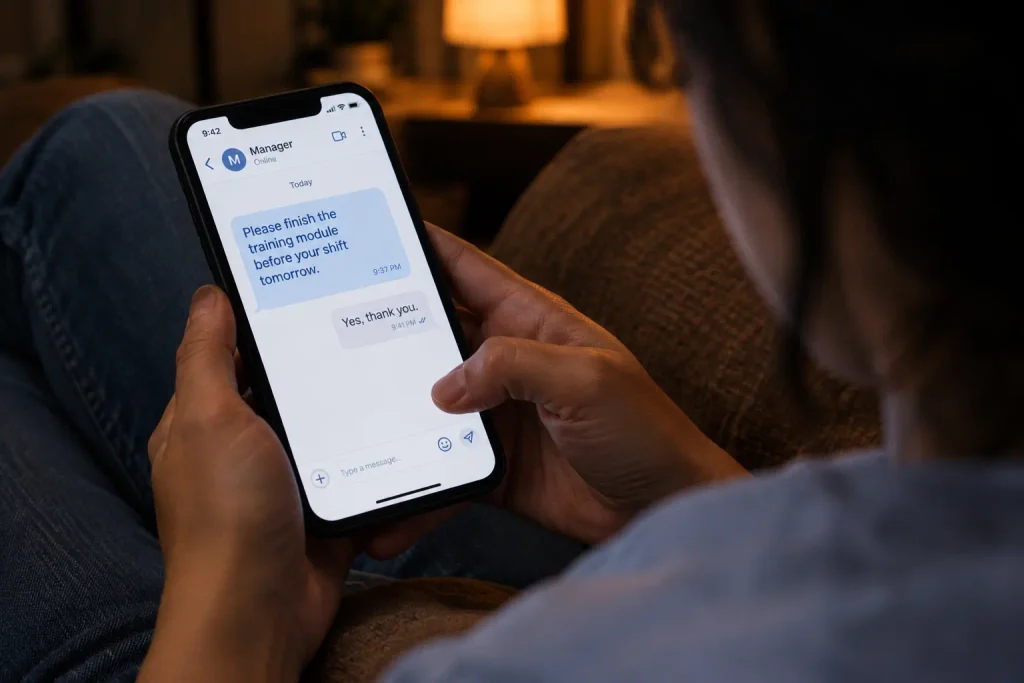
How does the “Suffered or Permitted to Work” doctrine apply to off-the-clock training?
If management knows you are completing training modules at home and doesn’t stop you, they have suffered or permitted the work. This makes it legally compensable time, regardless of company policy, meaning they owe you pay for those off-the-clock hours.
The Learning Management System (LMS) scam: estimated time vs. actual hours
In 2026, the biggest threat to your paycheck is the corporate Learning Management System (LMS) / Online Modules scam.
Many companies claim an online training course “should only take 1 hour.” They will only pay you for that estimated hour. However, the software might include unskippable videos and quizzes that actually take 1.5 hours to finish. Under the law, your employer must pay you for the actual time it takes to complete the work, not their fictional corporate estimate.
Retaliation and the “highly recommended” HR trap
Employers are smart. Instead of saying a training is “mandatory,” a manager might say it is “highly recommended for your professional development.”
Do not be fooled. If skipping this “optional” training means you get written up, passed over for a promotion, or given fewer shifts, it is not voluntary. If an employer takes Retaliation / Adverse Action against you for skipping it, the USDOL considers the training mandatory. You must be paid.
Can a restaurant apply the tip credit during a job shadowing shift?
No. During onboarding or Job Shadowing, you are not receiving tips from customers. Therefore, employers cannot legally apply the Tip Credit. They must pay you the full standard minimum wage for all compensable training hours, not the reduced tipped-worker rate.
If you are hired as a server or bartender, restaurants love to have you follow an experienced employee around for a week. This is called Job Shadowing. Because you are not actively generating your own tips during this period, it is completely illegal for the restaurant to pay you the sub-minimum tipped wage (e.g., $2.13 per hour federally). They must pay you the full state or federal minimum wage until you are working on your own and collecting tips.
Are pre-employment working interviews considered wage theft?
Yes, if you do productive work. A Working Interview is only legal as a brief, unpaid skills test. If you are completing actual tasks or serving customers, it is illegal unpaid labor and qualifies as Wage Theft.
The Working Interview is a growing corporate loophole. A company might ask you to work a four-hour “trial shift” to see if you are a good fit, completely unpaid.
Here is the legal reality: an unpaid skills test is only legal if the employer gains absolutely no benefit from your work. If you are serving real food to real customers, answering real customer service calls, or writing usable code, the employer is profiting off your labor. This is Wage Theft. They must pay you at least minimum wage for those hours.
| Situation | Is It Legal Without Pay? | FLSA Reason |
| New Hire Orientation | Illegal | Mandatory and job-related. |
| At-Home LMS Modules | Illegal | Employer benefits from the work. |
| Working Interview (Serving Tables) | Illegal | Productive work is being performed. |
| Voluntary CPR Class on Weekend | Legal | Unrelated to current job duties & truly voluntary. |
Practical Case Study: Reporting an employer to the Wage and Hour Division (WHD)
Consider a retail worker forced to finish ‘optional’ LMS modules at home to get promoted. When HR refused to pay, she filed a Wage and Hour Division (WHD) complaint. Because the training was tied to advancement, she won full back pay for wage theft.
Let’s look at a real-world scenario. David applied to be a dental assistant. The clinic asked him to come in for a six-hour “working interview” where he actually cleaned instruments and assisted with real patients. At the end of the day, they didn’t hire him and refused to pay him for the six hours.
David knew his rights. He filed a formal complaint with the Wage and Hour Division (WHD) and his State Department of Labor / Labor Commissioner. Because he performed productive work that benefited the clinic, federal investigators ruled it was illegal wage theft. The clinic was forced to pay David his owed wages, plus heavy federal penalties.
Frequently Asked Questions (FAQ) About Unpaid Training
If your employer asks you to work for free, you need to protect your paycheck. Below, we answer common questions about overtime rules, filing State Department of Labor complaints, and what to do if you face illegal retaliation for demanding your rightful training pay.
Can an employer force you to do training on your day off unpaid?
No. An employer can require you to come in on your day off to complete training, but if the training is mandatory, they absolutely must pay you for that time. If those extra training hours push your total weekly hours over 40, they must also pay you overtime at time-and-a-half.
Do I get paid for online training done at home?
Yes. Where you complete the training does not matter. If your employer requires you to watch safety videos, complete HR onboarding, or take compliance quizzes on your laptop at home, that is legally considered compensable hours worked.
Does an employer have to pay for mandatory certification?
This is a tricky distinction. Under federal law, the time you spend attending a mandatory certification class must be paid. However, the financial cost of the actual physical license (like a Food Handler’s Card or CPR certificate) can sometimes be pushed onto the employee, depending on specific state laws and whether the certificate is portable to other jobs.
Disclaimer: The information provided on this website does not, and is not intended to, constitute legal advice. All information, content, and materials available on this site are for general informational and educational purposes only. Laws regarding employment and labor rights frequently change, and while we strive to keep our content updated, the information on this website may not constitute the most up-to-date legal or other information.
Use of, and access to, this website or any of the links or resources contained within the site do not create an attorney-client relationship between the reader, user, or browser and the website authors, contributors, or its owners. We are an independent publishing platform, not a law firm.
Readers of this website should contact a qualified employment attorney in their specific state to obtain advice with respect to any particular legal matter. No reader or user of this site should act or refrain from acting on the basis of information on this site without first seeking legal advice from counsel in the relevant jurisdiction. Only your individual attorney can provide assurances that the information contained herein – and your interpretation of it – is applicable or appropriate to your particular situation.
References & Official Legal Resources
To verify your rights regarding compensable hours worked, training regulations, and federal wage protections, please consult these official government resources:
-
U.S. Department of Labor (USDOL) – Wage and Hour Division:
Review official federal standards regarding compensable time, minimum wage, and overtime rules under the USDOL Fair Labor Standards Act Portal. -
Electronic Code of Federal Regulations (eCFR) – 29 CFR § 785.27:
Read the exact statutory text of the FLSA 4-part test for lectures, meetings, and training programs at eCFR 29 CFR § 785.27 Guidelines. -
Legal Information Institute (LII) – Cornell Law School:
Explore legal definitions and court interpretations of “suffered or permitted to work” and off-the-clock labor at the LII Federal Training Pay Overview.
Keywords: is unpaid training legal, does an employer have to pay for training, is mandatory orientation paid, flsa 4 part test training, off the clock training wage theft, are working interviews legal unpaid, unpaid online training at home